Showing posts with label samples. Show all posts

Monday, October 08, 2018

Teig Saying "Goodbye"


"It's an owl!" said my friend, the driver.

"It's a hawk!" I said, unable to see its head.

While driving to Cabot last night, we encountered a bird in the middle of Danville Hill Road. My friend had only just warned me that he simply could not stand the thought of killing a living creature with his car, that he even swerves for insects.

Stopping immediately, headlights on, I was expecting whatever it was to move off quickly when we pulled up. But it sat there. Finally, it turned its big head as if looking straight into my eyes.

"It's an owl," I agreed.

Neither of us had ever seen one before, at least not in the middle of a dirt road. Up high up in a tree, maybe, but not on the ground.

"It's caught something," I said.

As we pulled the car around the bird, it finally lifted off, relaxing its grip as it did. A single poplar tree leaf fluttered to the dirt.

There began a discussion in the car of what an impressive moment that had been, one that others assign great meaning to — since the time of the Greeks and Romans.


The owl was carrying a message.

Could it be my friend Teig Hogan saying "goodbye"? They'd just gathered down in Virginia for an informal memorial the day before. I'd sent best regards along with a link to some images of him, hoping to participate remotely.

I knew he didn't have long, but I'd missed that last call — phone upstairs when I was downstairs kind of a thing. Of course, I wish I'd called him back.


Goodbye, Teig. We'll play more trivia when I get there.


October 8, 2018

Wednesday, May 30, 2018

Supercalifragilisticexpialidocious

Much of interest stands out when pondering America's Most Misspelled Words state map of 2018 from Google Trends. Consider the states whose residents cannot spell "beautiful" without a Google search:
  1. Arizona
  2. Arkansas
  3. California
  4. Colorado
  5. Illinois
  6. Indiana
  7. Massachusetts
  8. North Carolina
  9. Virginia
  10. Washington
  11. Wisconsin
Are these Google searchers seeking terms to describe their surroundings, attract a mate, or describe an automobile?

It should not surprise that people from Connecticut don't know how to spell "sincerely" — or that West Virginians stumble on "apparel". Even knowing the ingenuity of Vermonters, one might worry about their inability to spell "solution". 

While Kentuckians are trying to figure out what a "schedule" is, the nouveau riche in Florida struggle to spell "hors d'oeuvres". 

  • Why should Maine-iacs desire to spell "Connecticut" so often? 
  • Why would the people of landlocked North Dakota wish to buy a "yacht"?

Most interesting of all, perhaps, is why the people of Georgia, Michigan, Minnesota, Ohio, Oregon, and Texas are suddenly so interested in spelling a word "first attested" in the 1940s.* According to the film that popularized the term, Disney's 1964 Mary Poppins, it is "something to say when you have nothing to say."

Perhaps that solves the mystery. 

SEE ALSO: 'Resume,' 'Beautiful' and 'Fiancé': The Hardest Words for Americans to Spell by Each State

*Oxford English Dictionary


Wednesday, August 30, 2017

Build the Wall of Perception: It's the Smart Move

U.S.-Mexico Border Wall
The big problems with the much-promised wall along the U.S.-Mexico border are that it:
  1. Takes time to design, approve, and build.
  2. Costs a bunch of money to build and maintain.
  3. Spoils the scenery.
  4. Disrupts natural flows.
Air, water, and wildlife have a natural flow, after all. One day it might even be necessary to move a number of human beings across the border (either way) for military or humanitarian reasons.

An extended physical wall is also difficult and expensive to update and upgrade over time. 


What a wall doesn't protect us against

Most importantly to this discussion, a physical wall along the Mexican border does not protect us against those who illegally:
  1. Go around the wall.
  2. Tunnel under the wall.
  3. Fly high above the wall.
In fact, it encourages exactly this sort of evasion.


Enforcing existing laws creates a wall

We have prevailing laws that protect against illegal immigration — and protect us from related misbehavior. When properly enforced these laws create a "wall of perception" that says to those:
  1. Thinking of entering the country illegally, "Don't!"; and
  2. Who are already here illegally, "Leave!"
The effect of building this wall of perception is already clear. In the few months since the installation of a new president in the Oval Office in January 2017, a national leader intent on reducing illegal immigration and enforcing related laws, unwanted traffic across the Mexico border has dropped 70%. 


Enforcement protects us everywhere

A physical wall along one border does not. Instead, it encourages entry somewhere else along our many border miles elsewhere:
  1. Our Lower-48 states share a 3,987-mile border with Canada to the north, and
  2. A 1,538-mile border surrounding Alaska.
  3. The length of all our shorelines totals 95,471 miles.*
These are exposed national border miles that a wall along the Mexico border does not protect — and which those deterred by such a wall are further encouraged to try.

Enforcement of the laws works on those who evade a border wall, while continuing to press on already-resident border jumpers. 


Technology adds to the wall

Instead of building a solid, unbroken border wall, towers packed with detection equipment might be spaced along the Mexican border:
  1. The towers would be connected underground by above- and below-ground (tunneling) detection devices. 
  2. At the top of each tower would be drone platforms (some tethered**) for continuous surveillance runs and immediate-response to alerts.
  3. Detection devices would be positioned at top of towers for help with low-flying aircraft — including drones. 
Other robots can used to aid interdiction, too.

Protection that relies on technology can be upgraded easily as science progresses. And use of surveillance technology adds to the sense that somebody's watching at all times. Such technology can be developed and tested along one border and subsequently applied elsewhere.


The smart move

Build the Wall of Perception by enforcing prevailing laws and applying technology appropriately. It's the smart move.


*The National Ocean Service reaches that enormous number by adding together all the inches of exposure around our Atlantic, Pacific, Hawaii, and other shorelines.
**Persistent Aerial Reconnaissance and Communications (PARC) drones stay up in the air indefinitely, and fly up to 500 feet from base, attached by a microfilament that transmits power and data.

Sunday, November 20, 2016

Sweet Virginia Calling

Eli Cook in Bethlehem, NH
Eli Cook came to town last night. Or at least he came northward enough for me to drive over and see him. It was like Sweet Virginia calling.

On the way into Bethlehem for the show,1,2 Willie Nelson appeared on the radio singing my favorite "Funny How Time Slips Away". It might have been the single song that pulled me up and out of where I was at the time I encountered early Willie.3

Eli was the rising blues phenom.

Bob Taylor4 at Rapunzel's in Lovingston5 was perhaps his biggest proponent. I caught Eli play at that venue, in Scottsville for the Fourth of July, and later at a weekly gig he had in downtown Crozet.

Admiring his 12-string guitar in Bethlehem, I was wondering who made it when thought I just caught the "R" and maybe the "dge" of a logo on the headstock. Rockbridge Guitars?


That's a name out of my past.

Sure enough, it was the Randall Ray and Brian Calhoun luthier operation, which started in Lexington where they are from.6,7 They made his guitar, a (for them) rare 12-string. My interest in bluegrass started while a student at Washington and Lee University in Lexington, and it was a Lexington bluegrass band that opened up the music scene for me in Charlottesville many years later.8 Brian and Ray both played with them.

I got to compliment his sweet parents on how well-mannered they raised him. Eli agreed to play a charity performance at a summer festival I helped organize in Harrisonburg several years ago. His dad helped him set up.


Speaks well of the whole Cook family.

On the way out of town after the show "A Place in the Sun" by Pablo Cruise came on the radio. As far as I can recall I have never heard this song on the radio before, even during the group's heyday.9 I only know the song because it was played over-and-over on my roommate's stereo in my Washington and Lee dorm room.10

Maybe the Gods of Music put this particular song on the radio at that precise time in case I missed that Eli coming to town was like . .


Sweet Virginia Calling.


1. find any meaning in the town name?
2. just across the Connecticut River from where I live in Vermont.
3. in Houston, just popping out of "corporate America", and thinking about pursuing my writing.
4. then proprietor of Rapunzel's who was at the Prism Cafe in Charlottesville the night I became a poet, Bob subsequently named me poet laureate of that coffeehouse/bookstore/venue.
5. where Eli was born and from where he currently hails.
6. they've now moved to Charlottesville.
7. as their website says: "Rockbridge Guitars takes its name from Rockbridge County, Virginia, as homage to the homeland of the luthiers."
8. I also bought my first guitar at Rockbridge Music in Lexington.
9. the title song of the group's third album (1977), the single only reached 42 on the charts.
10. his high school girlfriend had just left him, so perhaps the way-more popular single "Whatcha Gonna Do?" was soothing; he's also nephew to Boz Scaggs.

Monday, November 14, 2016

"Until It's True It's Just Bulls@%t!!"

At a recent writer event in Burlington, a rather tall woman who had been signing people up for the open mic started things off with an original ditty that demeaned our newly-elected president's private parts, brain size, and children.

This hastily-constructed contribution to literature turned on whatever rhymes with "teeny" and "weenie". It encouraged considerable laughter from the largely female audience.*

Applause was energetic.

Appearing seventh on the list, I shared a political poem I'd written recently:

We've got our very own Dilma
The prez they impeached in Brazil
The difference is we already know
About her and her husband Bill.**

I then shared how a fellow poet believed that what we have on Hillary Clinton is "unsubstantiated innuendo". Thinking this might make an excellent title for a detailing of Hillary Clinton's crimes, written as a "list poem", I promised to keep such in my back pocket in case I had to be subjected to further readings of the teeny-weenie sort.

Keying off a reading of an anti-war poem, I then read my narrative poem "An End to War". Several people filed out as I read. The singer-songwriter who'd appeared just before me kept his eyes glued to the floor as I left the performance area. I reached out my hand anyway, saying "Good job!" He responded in kind, finally looking into my face.

The male emcee, a noted radio show host from New Hampshire, took center stage again, saying something to the effect of "sounds like somebody's been getting into the Heady Topper".***

A sweet lady came up to me at the food table . .

. . and said: "Thank you for what you said. That's exactly what I wanted to say after I heard her read." She had been a Bernie supporter. I gave her a hug, noting that we needed to be loving and tolerant.

The co-organizer of the writer organization came in later, as I was leaning on the back wall. She pointedly said positive things to the teeny-weenie "poetess" seated nearby, averting her eyes as she passed by me.

The one male about my age . .

. . who I thought by his thoughtful look might actually be on my side, came over and said he liked my poem. He then opened up a political discussion of how we must somehow come together as a nation. I asked:

"Does starting off an open mic by demeaning the president-elect's genitalia, brain size, and children qualify?"

The sweet lady came over and started in on him, mentioning Hillary's wars. He wouldn't hear any more of what she had to say because he didn't believe it, so she left the discussion. He said more than once:

"The problem is that I don't believe what you're saying about Hillary Clinton."

I agreed. That is indeed the problem.

He and millions of other Americans refuse to accept the facts about her. I don't know if it was the alcohol speaking — he seemed to be drinking water — but he then shouted:

"Until it's true, it's just bulls@%t!!"

This left me wondering if he meant until it's proven — or until it appears in the media he listens to?

Or is it until she's actually locked up.


*how might they react if a man got up and said the same things about Hillary and her daughter?
**the actual differences are: 1) in a sea of corruption around Dilma Rouseff in Brazil, the legislature got her on a rather minor charge (fiddling with economic data); and, 2) guilty of a massive amount of corruption and numerous crimes herself, Hillary may never have the chance to be impeached.
***appearance of which, rolled in on a dolly by an organizer's ten-year-old son, met with great applause earlier.

Thursday, March 26, 2015

Coincidence Corner: Part II (Vermont extension)


When I first relocated to the Northeast Kingdom of Vermont — aka "Moose Country", with Canada immediately north and New Hampshire east — I was in a desperate search for public WiFi. 

Electricity finally reached this area in the late 1930s, why would there be public WiFi anywhere in 2008?

The nearest town had no cafés, not like you'd see elsewhere in the United States. McDonald's had one electrical outlet for all of its customers, and that one source of power put users in direct sunlight in the afternoon.*

Hope came in the form of indications that a real-life café was coming to town.

First, a sign above the building appeared. Peering in hopefully, I could see an acoustic guitar leaning up against the wall. Furniture slowly appeared. 

Some nine months later, The Grindstone Café opened — and they did indeed offer WiFi with ample electrical outlets. The owner-founders were two guys out of Keene, New Hampshire — one of them a musician, teacher of guitar, and guitar fixer.**

Lounging comfortably in my new spot, consuming way less coffee than would compensate for the WiFi and electricity I was consuming, I regaled these new barista-owners with stories of my musically-driven, central Virginia coincidences.

When I'd hear my Virginia musician friends' songs play on the radio station at the café, I'd excitedly make the connection for the barista-owners.

One day an older guy tried to enter the coffee shop but had difficulty getting up over the threshold. He'd step up, then fall back. Overcoming that barrier, Otto Kremer (1943-2018) energetically grabbed for the guitar and started singing.

He wrote songs, one of them having just played on NPR the Sunday before. He told tales of having once run a live music venue in St. Albans, Vermont — a story with a very wild ending.***

Here he was, a true musician, in fulfillment of the signs.

Months later Otto came in with a bag over his shoulder and asked if either of us — the non-musician barista-owner or myself — knew anything about streaming. "I'm sure Ben can help you on that, he's the technical guy around here," I deflected to the co-owner.

"That's good," he said, "because I have a movie I want to watch that my nephew produced. It's called The Parking Lot."

"Oh?" I asked, my coincidence bell ringing. "What's the film about?"


"It's about this parking lot in Charlottesville, Virginia. A bunch of musicians work there taking money, and this is their story."


I knew that parking lot. My room in the Chancellor Apartments looked out over it. I'd walked across that parking lot many times.

The Corner Parking Lot was at the heart what I'd come to call "Coincidence Corner" because of all the coincidences that had happened to me there.

Two of the biggest synchronicities I experienced on Coincidence Corner involved Buena Vista Social Club, a record the musician-friend who kicked off all my Charlottesville coincidences had recommended to me.

"Your nephew worked on this film, Otto?" I asked, returning to the matter at hand.

"Yes, my nephew Mark. He's a musician, too."

"What group did he play with?" I asked sensing where this might be going.

"6 Day Bender," he responded.

"I know Mark," I said. "I watched him play in that group at their CD release party."

"Oh," he said. "My sister lives in Charlottesville."

So many times this exact sort of thing happened to me, even outside of central Virginia, I should have long since gotten used to it.

Then Otto pulled a CD out of his bag, intending to give it to Ben to play for his customers. Catching a quick glimpse of the CD cover, I asked tremulously, "What CD is that, Otto?"

He pulled it up, coming closer for me to see. I covered my eyes with my hands and lowered my head. 

"Don't tell me," I said.

It was indeed Buena Vista Social Club.


*they have since made amends, converting their restaurant into a cross between a swanky 1990s restaurant and a lawyer's office, replete with outlets everywhere.
**they had been thinking about offering guitar-related merchandise in their café.
***involving drugs, escaping police capture to another state, etc.

Thursday, July 31, 2014

Why Did Willie Watson Leave Old Crow?

Willie Watson

Creative differences.

That's the usual reason given when somebody exits a band: The individual and the group were headed in different directions, so they had to break up.

Though fans of Old Crow Medicine Show have yet to receive a fully satisfactory explanation for why founder Willie Watson left the Appalachian string band in Fall of 2011, new releases from each — combined with dedicated tours (both coming through Vermont within days of each other) — have finally provided the artistic reason they had to split.


Judging by the stated intention of his solo debut album Folk Singer Vol. I, and recent appearing at Higher Grounds in South Burlington, Willie has redefined himself as a classic American folk singer. By all indications, he's establishing himself as one of the greats, and in very short order (yes, he's that good).

Even though this development reconnects him with his own musical roots grown in the Finger Lakes region of Upstate New York, it all came about like a happy accident. When he first popped loose of Old Crow he didn't know which path to take. Start a new band? Go solo? He'd never pictured himself as a solo act. When friends coaxed him on stage, and things started to develop, he was trying to perform new songs he'd written himself. But the audience reacted better to the older, traditional songs — and he enjoyed performing them better.

The rest is history.


For its part, Old Crow itself was facing a bit of a two-part identity crisis: How to define itself without Willie Watson, and how to make itself bigger than its monster hit "Wagon Wheel". That's what their new album Remedy remedies. As Sam Pfeifle of The Portland Phoenix puts it in his review of the new release: "Such is Old Crow’s magic. They make brand-new songs sound like traditionals and traditionals sound like songs you’ve never heard before."

This musical philosophy, combined with an outrageously fun — and hugely popular — roadshow that stopped at the Shelburne Museum— suggest the direction the band is increasingly going. And thus the divergence: Willie reverting to authentic relayer of traditional folk music, Old Crow recreating traditionals, or the traditional style, in a contemporary way.

Willie is all about rooting himself in traditional authenticity; Old Crow is all about reinterpreting tradition for modern audiences, even the popular mainstream.

These separate appearances in Vermont within days of each other, by the now-separate acts, indicate solutions have been found to their dilemmas. The solutions suggest that the break was necessary and good for each musical act — as well as for the rest of us who appreciate their music.

So what was the real reason Willie Watson had to leave Old Crow Medicine Show?

Creative differences.

Friday, October 08, 2010

What's Missing

So much was missing from the October 3, 2010 New York Times (NYT) “Sunday Opinion” section that what was left out outdid even what was unjustifiably there.

Non-Leftist Viewpoints

In the last month of an historic political campaign—the story of which is mainly that of a resurgent, patriotic energy swamping the Left—we find no opinion in the Sunday section to counterbalance Leftist spew. With conservative NYT columnist David Brooks so eloquently smashing the Insurgent-Right-Wingers-Threaten-Republican-Party1 “narrative”2 on the same page recently, perhaps it's understandable. Without such a healthy counterbalance this time it's left to feeble minds like mine to highlight what's missing.

Explanation of Terms

Those of us who don't spend our time developing wildly perverse theories to make life fit acceptably into our own beliefs might need a little help understanding what these guys are talking about. Especially as they use inscrutable terms they seem to make up as they go along. What the heck, for example, I ask Thomas L. Friedman, is the “radical center”? a “tortured compromise”? a “super-consensus”?3

Frank Rich spends his entire “The Very Useful Idiocy of Christine O'Donnell” trying to get us to see what a “useful idiot” is (presuming that Republican operatives knew all along). This at least gives us a chance at understanding the oxymoronic term.4 But what about “conservative grandee”? a “phantom front organization”? or “corporate pork”?5

In a year of unprecedented anti-Left political energy upsetting the entire electoral and party system—when the Wall Street Journal, for example, actually reports on this remarkable upsurge as an actual historical movement made up of actual concerned Americans—we call this "fair news coverage".

But when The New York Times unabashedly anoints The Great One Who Would Save Us All as representing the Second Coming, along with the rest of the Leftist Media Bloc, all but ignoring responsible coverage of competitive campaigning and viewpoints—unless it could be presented like foam out of the mouth of a rabid dog—we call it "mass propaganda" (which indeed it was).

Logical Support

With a piece titled “Third Party Rising”, especially one starting out in Ancient Rome, we might expect at least cursory reference to a few items that could aid understanding of the phenomenon of multiple parties. Some mention of England's experience, both historical and recent. Perhaps even our own history, together with a discussion of at least the larger one or two of a fairly long list of third parties that have been a part of the U.S. political scene down through the years. What about our own experiments with third parties has soured our own hopes in that direction?

But the most glaring omission, one that even the most casual reader will catch, is the large number of Americans identifying themselves as “sympathetic” to the Tea Party message.6 Might not an article entitled "Third Party Rising" name this group as the potential spring bed for this “third party rising”, “one definitely big enough to impact the election's outcome”? Especially considering that's obviously what prompted the writer to take up his pen on this topic to begin with?

What America needs, Mr. Friedman says, is a third party to “look Americans in the eye and say:
'These two parties are lying to you. They can't tell you the truth because they are each trapped in decades of special interests.'"
Isn't that what the Tea Party is doing?

The Tea Party has already proved itself big enough to affect the outcome of this election in a big way. Yet Mr. Friedman apparently sees no future for it, only to introduce “two serious groups”—apparently new-on-the-scene—that are supposedly developing "serious" third parties.

The Tea Party may not seem serious enough to the author, but it must seem serious as a heart attack to those sure-lock candidates of both parties it's brushing aside like so much debris.

Leftist Names

Leftist billionaire, George Soros
Amidst all the names of billionaires, supposedly so hidden behind their “phantom front organizations”, and all the names of the rightly outraged people7 and politicians who have the nerve to utilize the American political system to challenge those who seem to be destroying the country's greatness so very quickly, the only Leftist name we find on first reading is Bill Maher's (so appropriate). George Soros, darling billionaire of the Left who set the entire political-giving pattern now being decried by the Left, is missing from the list.

We do find one reference to The Great One Who Would Save Us All:
“However much these corporate contributors may share the Tea Party minions' antipathy toward President Obama, their economic interests hardly overlap.”
This is the principal Leftist whose policies, attitudes, and words have created this political rebellion throughout the nation. He happens to preside over us all. Surely he merits more than a single reference to how much this patriotic group detests him. What about extolling his great accomplishments in office.

Mr. Rich has no interest in building anyone up, apparently, or saying anything positive about anyone--not even the Leftists who are causing all the problems to begin with.

Biggest Thing Missing

The most important thing missing from these columns is what is missing, it might be said, from any Leftist political or social commentary.

The entire premise of “The Very Useful Idiocy of Christine O'Donnell”, written by The New York Time's flagship columnist, is that American billionaires—so careful to work the system without being seen to—willingly and knowingly promote an idiot politician as a front to their activities. This is why, he claims, the crafty likes of Karl Rove withdraws his criticism of her, and why these super-smart movers and shakers continue to support her. Rather than promoting someone who can actually take power, they use this loss-leader so they can continue to operate in the dark.

Such people only behave in the manner described in a Leftist nightmare—not in the Real World where the rest of us live.

We may be witnessing the genesis of a brilliant new political tactic. Let's call it “billionaire baiting”. An interesting game to be playing, especially with The New York Times on the financial ropes—not able to spew raw political propaganda and get enough people to pay good money for it. One of these attacked tycoons might go Murdoch and buy out the entire operation thereby redressing this miserable misapplication of resources.

What seems to be lacking in The New York Time's finest mind is perhaps the most important thing of all:

A Dose of Reality.

Definition of Idiocy

With so much emphasis on "idiocy" in Mr. Rich's column, he might have included a definition of the term. Here's what Merriam-Webster says it means . .
  1. —usually offensive: extreme mental retardation
  2. —something notably stupid or foolish
It lists synonyms as: absurdity, asininity, bêtise, fatuity, foolery, foppery, folly, imbecility, inanity, insanity, lunacy, stupidity.8 

With all this in mind, we might add a third definition for "idiocy" . .
3.—Frank Rich's October 3, 2010 column on "useful idiocy" in the once-great New York Times.
It must be a "useful idiocy", that of Mr. Rich, as somebody is able to justify continuing to pay him for it. I'm thinking he plays an important role in the Left, that of Useful Idiot: he provides the salve, by means of his idiotic theories, for Leftists unable to face the facts of human existence and the truth of human behavior.

1. "The myth of the tea party backlash: There is no evidence that the tea party will drive independent voters to the Democrats" by David Brooks, Sunday, September 19, 2010.
2. The Left's favorite word, followed closely by "notion", and more recently “conflate”.
3. While Mr. Friedman's explaining his terms, perhaps he could tell us what he means by “the worst existential crisis in our economy and environment in a century”. We can dope out “two-party duopoly”, but what self-respecting columnist would use such a clumsily redundant phrase borrowed from economics?
4. The term originally applied to Soviet sympathizers in Western countries—held in contempt by the Soviets, but being used cynically by them.
5. While Mr. Rich is giving us an explanation of his terms, he might also tell us what a "Roger Ailes re-education camp" is and why Karl Rove would ever be sent to one. Could he also please tell us what it means to receive an “outsize cut of the red ink”? [The only politically non-aligned opinion on the page, Arthur S. Brisbane's “The Public Editor” piece, perhaps offers them a solution to their apparent making-it-up-as-we-go-along syndrome. The authors could give us explanations in the unlimited space of the NYT website as Brisbane suggests for scholarly attributions.]
6. Fifty two percent (52%) of Americans "feel sympathy" with the tea party movement. SOURCE: "Big Government is Not the Issue" by Steven Kull; August 19, 2010.
7. Referring to his fellow newspaper columnist as "blogger Michelle Malkin" certainly lacks professional courtesy, while perhaps indicating professional jealousy (she at least has the ability to see things as they really are without developing loopy theories to make the world and its people work according to her own preconceived notions).
8. And "related terms" as: absurdness, craziness, foolishness, inaneness, madness, senselessness, witlessness; buffoonery, monkeyshine(s), shenanigan(s), tomfoolery; drivel, humbug, nonsense, twaddle; blunder, bungle, flub, goof, howler.

Thursday, May 20, 2010

Cohen Cover Revelations

I grabbed Leonard Cohen's I'm Your Man off a dingy rack of DVDs at the local grocery store cum gas station. Didn't expect much; hadn't heard of most of the cover "artists".


It was godawful.

What a useless gang of washed-up has-beens, or maybe never wases, populated this sad collection. Some must have been pulled from punk rock groups. Family connections were everywhere apparent. It made me wonder if: a) the whole show was cast from people on Mr. Cohen's Montreal street; or, b) he wouldn't allow anyone onstage who might outclass him?


Then a revelation . .

After what seemed endless hours of agony, Antony (Hegarty) delivers (channels?) a musical masterpiece with "If It Be Your Will".1  Artistic genius, perfect from beginning-to-end.

Add his name to Jeff Buckley's for out-of-the-park Leonard Cohen covers.2


And another . .

Teddy Thompson makes "Tonight Will Be Fine" country, not quite what the songwriter had in mind. He makes me believe.

But Teddy's version of "The Future" is a stunner. My guess is he owes much to Hal Willner3 for arrangement. Whatever it took, it's sustained, unmatched brilliance — live for seven full minutes.4


1. my ear always converts it to "If It Be Thy Will".
2. it was a commemorative show in honor of his father Tim Buckley, produced by Hal Willner, that launched Jeff's career.
3. when he commemorates Richard and Linda Thompson, we know who'll be there (with kid sister Kami).
4. so good it makes me enjoy the song in spite of its troubling message.

Sunday, June 10, 2007

Coincidence Corner

Buena Vista Social ClubNot long after I arrived in Charlottesville in 1999, I encountered a bluegrass band that changed my life. Two members of this musical collective were performing at Michael's Bistro1 on University Avenue, just a couple of doors up from where I was staying (at the Chancellor Apartments).

I was immediately struck with the sound of this group, and that the singer came from Lexington—where I spent my first year in college (and first encountered bluegrass music)—and the guitarist came from Richmond—where I'd attended high school.

After befriending the impresario of this act,2 he started recommending I listen to Buena Vista Social Club. On the day I finally got around to buying the album, following repeated nudges from my new friend, I walked just up the street to Plan 93 with yet another Michael in the story (who lived down the hall).

After making our purchase, I wondered about heading up 14th Street, crossing over the railroad tracks and parking lot behind the apartment building where we lived, and getting home that way.4 For no real reason, we decided to stroll directly a block or two up University toward home. Right in front of our apartment we run smack into said musician walking with his friends.5

I'd never encountered him on the street; certainly never seen him in front of where I lived. On the day I finally buy the CD he'd been pushing me to buy, that's right where I see him—immediately after making the purchase he'd recommended.

We chatted about the CD, how he listened to it more than bluegrass nowadays. He asked if I had a room upstairs, and we parted rather clumsily.

Needless to say I became infatuated with Buena Vista Social Club, listening to it for hours on end with tears streaming down my face. The Cuban music spoke directly to my heart and it was healing my soul.

In the months and years since, the strains of Buena Vista Social Club have wafted through my life like a fugue. It seemed that each time my head was in a fog of some sort or another, I'd walk into some café and music from that CD would be playing through the speakers.

Fast forward to yesterday6 . .

Down on the famous Charlottesville pedestrian mall, meeting with friends, etc., I'd decided to grab a bite to eat on The Corner (at the old entrance to UVa)—which I'd long since started calling 'Coincidence Corner' for all of those same articles I'd experienced there.

After an enjoyable sub at Little John's deli—which sits right below Michael's Bistro—upon exiting I spy my friend Michael, the very one who'd helped me purchase that 'Buena Vista Social Club' CD at Plan 9 all those years ago. Now indistinguishable from a bum, I couldn't tell if he recognized me or simply wished to avoid my recognizing him.

I stepped into the new location of Plan 9, immediately next door to Little John's, for a coffee. What should be playing for all the customers to hear?

And not just one song, but the whole damned thing.

1. I always joke that they did me a real favor by naming this place (which quickly became my favorite) after me before I got to town.
2. Whose middle name was 'Michael' and whose father's middle name was 'Michael'.
3. Plan 9 was then located down the street a couple blocks, just past 14th Street (meaning it was actually on Main, 14th Street being where it changes names).
4. Thereby crossing the now-famous Parking Lot.
5. Will and Craig(?).
6. I should have know something was up: the live act I happened to catch the previous night in Harrisonburg was from Charlottesville and named Sons of Bill (way before they were big). My father's name is 'Bill', and the first three songs they did were among his favorites.

SEE ALSO: Coincidence Corner: Part II (Vermont extension)

Monday, July 18, 2005

Am I Considered Christian?

"You basically have the Christians, the Catholics, and the Jews."

That's my friend Warren, answering a recent question regarding religious observance in the United States. He'd said something along these lines a time or two before, so I piped up, being born and raised Catholic myself.


"Catholicism was the first Christian church," I protested. 

Warren stuck by his division and was not going to talk about it. He didn't "know what the f--k" we Catholics were.

Henry VIII established the Church of England1 essentially so he could remarry after divorcing — he did not invent Christianity by so doing. Neither did Martin Luther when he nailed his 95 Theses2 to the door of the Wittenberg Castle church, thereby kicking off the Reformation and Protestantism.


I would not allow us Catholics to be eradicated by the "protest-ants", the "schismatics", the "break-offs".3

When it's stated that 75% of Americans consider themselves to be "Christian", that number certainly includes Catholics. We make up 25% or so of the American population, after all. But many Christians in the U.S. do not believe Catholics should be counted with them.4


This may be a definitional thing. What means "Christian" in their minds? It could be the result of ignorance. Or was it historical?


Mayflower
In Europe, everyone knows the Roman Catholic church first spread Christianity, at least in the Western sphere. Martin Luther and Henry VIII came along later. But in the U.S., the English Protestants5 came first, at least in the Northeast. Catholic Spaniards stayed far to the south. 

The big Catholic waves came later — 1840s for the Irish, 1880s for the Italians. 

Warren, being from Massachusetts, home of the original landing of Puritans at the legendary Plymouth Rock, might very well see us Catholics as the bedraggled stowaways on ships manned by Protestants — as invaders not founders, upstarts not originals.

1. which, apart from breaking off from Rome and the matter of remarrying, did not substantially alter Catholic doctrine.
2. issues which have all been resolved since, save one.
3. I have also called them "splinter groups".
4. something I've observed most particularly in the South.
5. technically not "Protestant"?

Saturday, May 07, 2005

Hidden Blood

A constant source of wonder and amusement, and no small amount of consternation, is the number of times I'm taken for Jewish even without being asked.  Often I'm told "I thought you were Jewish."  Or "I just assumed you were Jewish."

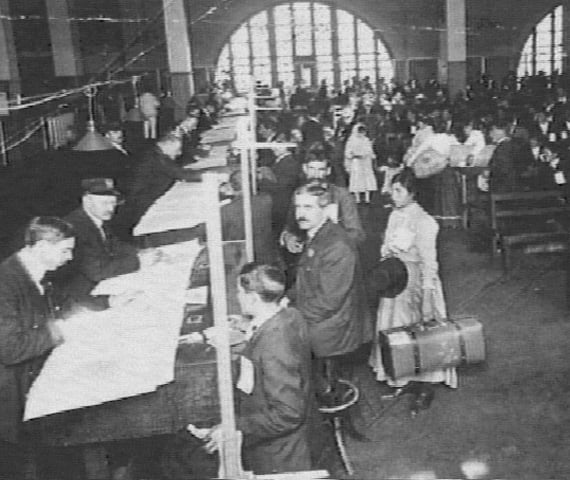
Their minds get set on this and it becomes a reality for them--no need to verify or confirm.

As a result of this phenomenon I've been the victim of anti-Semitism.  Once in college a friend reported that another student referred to me as a "jewboy".  How many times it's happened out of earshot, or affected my pathway in life, who can say.

The other night in a cafe, commenting on how differently northerners view male-female relationships than do southerners in this country, a college kid from New Jersey, who was born in Poland, took umbrage. To which I said "especially if they're from New Jersey, and especially if they're speaking Polish."

Depending on the audience, this could be handled humorously.  Instead, this kid came back instantly, and quite vehemently, with:  "And I suppose it's better when they're speaking Hebrew!"

What do you do with that? I did provoke him, in a way, but his response was based on a fallacy.  I was raised Catholic.

I've also visited Auschwitz in Poland, and know quite well their record on that score.  Most of the Jews exterminated during the war were done so on their soil, or so I've been told. When I was there in 1990, only 5,000 Jews continued to live in Poland.

So, do I respond out of righteousness for these atrocities against humanity? Do I protest proclaiming my actual religious allegiances? This seems a minor point against the former.

A complication does arise with my ethnicity.  On this my Polish friend may not have missed the mark by all that much.

The part of my ethnicity I believe I can vouch for is the one quarter Irish plus the one quarter Italian, both Catholic. The part that is somewhat questionable is officially one quarter French (from my father's side) and one quarter Lithuanian (from my mother's).

Actually, as I've been able to reconstruct it by various means, and through family denial and evasion, my paternal grandfather was a quarter Jewish ethnically and my maternal grandfather was a half.  So I consider myself to be three sixteenths Jewish ethnically.

Curiously, but perhaps predictably, the hidden blood on one side of the family found the hidden blood on the other.

I'm certainly not a practicing Jew, and have no real intention to convert. The whole concept of being "racially Jewish" is controversial in the Jewish community. And so, officially at least, I do not qualify as a Jew.

This doesn't change the way people see me, though, and short of wearing a priest's robe I see very little I can do about that.

Monday, April 25, 2005

"Excuse me, are you Jewish?"

Hasidic Jew
That's a strange thing to be asked walking down a busy sidewalk some morning in Washington, D.C.

Turned out an Hasidic Jew was looking for two Jews to meet a quorum for prayer service.

I replied that I was expanding my mind, did that count? 

"Not today", he said.

On noting the Nazi nature of profiling people on the street as to their ethnic appearance, he said

"Nazi-like would be telling you you're nothing."

Reminding him that the Nazis profiled as to Aryan-like features he claimed he couldn't tell what I looked like with my sunglasses.

I took the opportunity to ask him about the new Pope, "while we're on the topic of Nazis", I said, hopelessly prefiguring his response.

"What are you going to do, he was just a kid.  Let's see what he does now, that's more important," he replied dismissively.

He went back to his search for two more Jews, and I to my wondering at the impact of this new Pope on people of my faith.

Tuesday, December 07, 2004

I Walked by the State Department Yesterday (Part II)

(continued from "I Walked by the State Department Yesterday (Part I)" posted 12.6.4)

I remember the shiny wide halls of marble-like material, the elevators with deselect buttons (don't find too many of them no more), and the oh-so-important shiny shoes gliding in lockstep.

Overseas, at least, many of our supposed 'diplomats' are actually in the employ of the intelligence community.  I have wondered about my father in that regard, given his behavior, but I have determined he was an actual F.S.O. (Foreign Service Officer).

He made ambassador, if that's any indication.

But, just as a Naval officer, which he was, might bring home the anger he can't express at work, which he did, so might a U.S. diplomat apply what he learns on the job on the home front.  Treating his own family in ways the U.S. treats other nations, such as Iraq and Afghanistan.

So there's your wasted life.

Now a friend, a musician, a highly talented and intelligent person I know has fallen into their fold; never likely to return.  His first posting to the poorest of the world's nations, known for its unstable violence, was hard enough for me.  Knowing what faces him in a Foreign Service career is even harder.

I was on my way to a movie about the Italian mafia, in what the lecturer dubbed the "anti-Mafia martyr" genre.  She was asked after her talk if she was including in her definition of 'mafia' the broader behavior found in numerous groups worldwide--gaining what they want by force.

You can't drive past the State Department on 'C' Street anymore.  Guards at either end.  Kicking so many beehives overseas we have to protect ourselves from the backlash at home.

Oddly, the 'man of peace' turns out to the the four-star general who's stepping down as Secretary of State, Colin Powell.  At the time of his appointment I wondered at the paradox, a military man becoming our chief diplomat.  Not since George C. Marshall, another Nobel Peace Prize winner (1953), had we seen such a thing.  But George C. Marshall was a truly great man, and Colin Powell?

Now we see the hand the State Department plays so clearly.  We see it in Iraq.

What is this diplomatic corps anymore if the diplomats within wish not to go out into the field for fear of their lives.  Billion dollar fortresses now replace out humble diplomatic outposts.  Manned by geeks without uniform or military training.  Sitting ducks in our foreign wars.

We've kicked so many beehives over there we need to give them billion-dollar fortresses to live and work in.

Now I know where my life went.

Monday, December 06, 2004

I Walked by the State Department Yesterday (Part I)

My father's employer throughout most of his life stands almost monumentally.  The feeling I had was an eerie one, reminiscent of a life gone bad.  My father's and mine all at once.

I wasn't even sure I could walk past the front of the building, Washington, D.C. having been turned into an armed camp in recent years.  Cement blockade pieces guarded the sidewalk, together with an actual guard.

The way we've been kicking bee hives overseas we have to put up the netting back at home.  How much of the blame lays at these portals?

The sign said the street was closed for a while, but that could have been the side street.  I pressed on, encouraged by a woman I saw coming up the sidewalk the other way.  The guard regarded me suspiciously, as would be his wont, perhaps wondering when I might whip something weapon-like out from under the coat I draped over my arm.

Passing the side entrance I had an Ayn Rand Fountainhead experience--architect Howard Roark's "battle against the tradition-worshipping establishment." As in "individualism versus collectivism, not in politics, but in man's soul; the psychological motivations and the basic premises that produce the character of an individualist or a collectivist."

Something spewing, or feared to be so, from that 40s and 50s era, something Rand captures or alerts us to, but something more, too.  Something about the actual architecture of the building, industrial yet forward-looking, and the way it blurred my vision, made me feel the movement and the threat it posed.

More has emanated from that building than just the force of good or bad architectural design.  Conspiracy theories abound regarding the geeks at State running the world.

Joe McCarthy's McCarthyism, his "Red Scare", his witch hunt pinned Communists purported to be working from the halls of the State Department.

Perhaps our best known diplomat, our best known shaper of foreign policy, Henry Kissinger, winner of the Nobel Peace Prize in 1973, now viewed by many as a war criminal, ruled from the State Department.  And the White House as he combined his position with that of National Security Advisor, the better to avoid impediments to his impulse.

Since then Madeleine Albright discovered somehow during her term as the first woman Secretary of State that she was Jewish . . quelle surprise.  Anyone in the know knows she knew it all along.  Even she stands accused of war crimes.

(to be continued)