Showing posts with label climate. Show all posts

Saturday, May 09, 2020

"The Same Guys"

The same guys did projections
For climate as for COVID-19
Let's hope they make corrections
Given results we've seen.

May 9, 2020


Thursday, April 19, 2018

Ice Age Question for Climate Alarmists

  • probably the most severe ice age of the last billion years occurred from 850 to 630 million years ago during the Cryogenian period
  • it may have produced a Snowball Earth with glacial ice sheets reaching the equator
  • a number of other ice ages have occurred on earth with glacial and interglacial periods
Questions for climate alarmists:
  • What caused the warming that brought this massive ice age to an end?
  • What caused the warming that brought an end to every ice age in the history of planet Earth?

Tuesday, April 17, 2018

Measuring Climate Thoughout the Biosphere

The biosphere (or ecosphere) — which measures about 12 miles from top to bottom — represents the sum of all the Earth's ecosystems operating in the atmosphere (air), hydrosphere (water), and lithosphere (earth) physical dimensions of the planet. The biosphere has existed for about 3.5 billion years.

Creating a comprehensive energy-in/energy-out model for properly measuring climate change involves temperature monitoring and weather activity/event monitoring in every area of these dimensions.


Related questions to climate scientists, therefore, include:


Lithosphere (earth)


Given that:

  • 95% of the world’s population is concentrated in just 10% of the land surface*
  • half the planet's population lives on just 1% of the land
  • half of the world's population lives in urban areas**
Questions:
  1. How are we capturing temperature data from less- or unpopulated areas of the Earth?
  2. How are we accounting for the effect of human activity — e.g., heat captured by buildings and pavement, incineration gases, pollution, etc. — when monitoring temperatures in populated areas?
  3. How are we monitoring temperature in higher ranges (mountains), in deserts, and in other difficult terrains, i.e., Antarctica?
  4. How far down into the earth (crust) are we taking temperature readings?
  5. How are we monitoring and factoring in the energy of tectonic movement, earthquakes, etc.?
  6. How is the energy/heat of volcanic eruption accounted for?
  7. How is the energy in the Earth's "core" factored in?
Hydrosphere (water)

Given that oceans:

  • cover approximately 71% of Earth's surface
  • comprise 90% of Earth's biosphere
  • are less than 5% explored
  • have total volume of approximately 320 million cubic miles
  • have an average depth of nearly 2.3 miles

Questions:
  1. How are we capturing temperature data from the unexplored 95% of the world's oceans?
  2. How are we monitoring temperature in lower levels of the world's oceans (down several miles) and in the coldest areas, i.e., the Artic and Antarctic regions?
  3. How are we capturing the energy of water and wave movement in the world's oceans?
Outside of oceans . .

  1. How are we measuring the temperature of freshwater bodies, e.g., lakes, rivers, ponds, creeks, etc., around the world?
  2. How are we capturing the energy of water and wave movement in freshwater bodies around the world?

Atmosphere (air)

Given the Earth's atmosphere consists of a . .

  • number of layers that differ in properties such as composition, temperature, and pressure — each of the layers having a different lapse rate, which defines the rate of change in temperature with height — e.g.
    • troposphere (up to 11 miles high) is the lowest layer, where three-quarters of the atmosphere's mass resides and the layer within which terrestrial weather develops
    • stratosphere (up to 22 miles) contains the ozone layer and is where most of the ultraviolet radiation from the Sun is absorbed
    • mesosphere (up to 53 miles) is the layer where most meteors burn up
    • thermosphere (up to 430 miles) contains the ionosphere region where the atmosphere is ionized by incoming solar radiation

Questions:
  1. How are we capturing temperature data from each of these levels of the Earth's atmosphere?
  2. How are we capturing the energy received, released, or deflected with events, activities, and movement in these levels of the Earth's atmosphere?

And finally . .
  1. how are all of these temperature readings being combined to create a worldwide average temperature?
  2. how are all the world's weather and other events that involve energy in the three biosphere dimensions being factored into this average?
  3. how are the energy and movement related to the rotation of the Earth, and their impact on climate, factored into this analysis?

*from a 2009 European Commission Joint Research Center map in World Bank World Development report.
**from a map was created using gridded population data compiled by NASA.

On a System to Measure Climate Change

H0: Human-generated C02 causes significant climate change.

We are unlikely ever to test such a scientific hypothesis properly. An effective, comprehensive biosphere energy-in-energy-out model would require substantial scientific understanding we do not currently possess. The timeline for measuring climate change is itself measured in billions of years and human activity that might affect it is only a minuscule portion of that
 — and the very tail end. 

But, we might still wish to develop a system for measuring climate change, and how rapidly it seems to be progressing toward some unliveable zone, to alert the citizens of the world to related danger.

Or, we might wish to develop a system for measuring climate change simply to counteract persistent efforts to connect human activity to dangerous change — with related efforts to control human behavior and economic activity
 — with the purported aim to save the world and its inhabitants from climate catastrophe.

Without such a system, which 
establishes an agreed protocol with governments and NGOs worldwide to . .
  1. put climate activity today in historical perspective with earth's experience millions and billions of years back.
  2. provide for consistent and even measurement of all relevant levels of the atmosphere (air), hydrosphere (water), and lithosphere (earth).
. . predictions of future catastrophe not based in any sort of scientific reality spin hysteria on conjecture founded only in speculation — becoming an out-of-control catastrophe-spinning machine which has no way of being reeled back in.

To this end, one of two outcomes of investing the time and money in developing such a system might suffice:

  1. debunking the purported between human activity and climate change, or at least
  2. defusing the related catastrophizing
It would likely be far less expensive than the alternative: massive governmental intervention in our lives and economic activity. Or transplanting ourselves to another planet.

We might also develop a better understanding of how natural events affect climate — volcano eruptions and "volcanic winter", for example — and how we might apply developing technology to mitigate their effect.


SEE ALSO:
"In science, consensus is irrelevant. What is relevant is reproducible results. The greatest scientists in history are great precisely because they broke with the consensus."
National Press Club 2005
on global warming


Friday, December 11, 2015

"Insistence on Orthodoxy"

"The rumpus, ignited by a few eco-activists and fueled by a mad BBC bureaucracy, has demonstrated the sort of foot-stamping insistence on orthodoxy not seen during peacetime since Oliver Cromwell’s Commonwealth in the 17th century."


Friday, November 20, 2015

"Based On Nonsense"

"When someone says this is the warmest temperature on record. What are they talking about? It’s just nonsense. This is a very tiny change period."
"Demonization of CO2 is irrational at best and even modest warming is mostly beneficial."
MIT Climate Scientist Dr. Richard Lindzen

"Policies to slow CO2 emissions are really based on nonsense. We are being led down a false path. To call carbon dioxide a pollutant is really Orwellian. You are calling something a pollutant that we all produce. Where does that lead us eventually?"
Princeton Physicist Dr. Will Happer

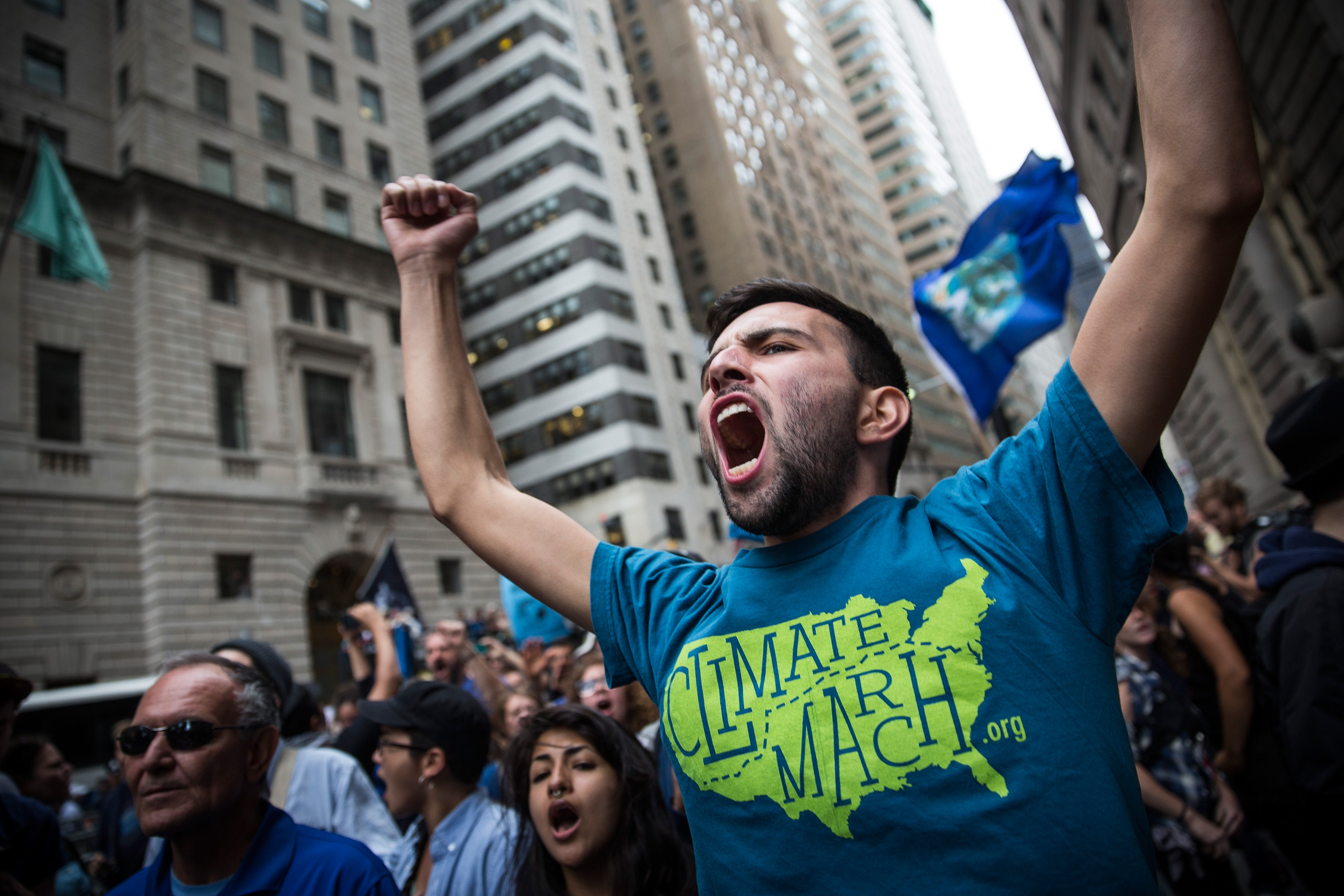
"We are dealing with pure political propaganda that has nothing to do with science."
Greenpeace Co-Founder Dr. Patrick Moore


SEE: Prominent Scientists Declare Climate Claims Ahead of UN Summit ‘Irrational’

Sunday, November 08, 2015

"Never Call It a Tax"

"Furthermore, if we were to charge a fee - oh, we must never call it a tax - on fossil fuels, wind would be way cheaper — way cheaper."


Wednesday, July 22, 2015

"Over the Edge"

“We don’t even know how far we’ve gone, or if we’ve gone over the edge. There are tipping points, feedback loops. This is not some linear set of problems that we can predict. We have to take measures against an uncertain future which may well be something no one ever wants. We are talking about extinction. We are talking about climate regimes that have not been seen for tens of millions of years. We’re not there yet, but we’re on our way.”


Wednesday, October 22, 2014

"The Science is Not Valid"

"The ocean is not rising significantly. The polar ice is increasing, not melting away. Polar Bears are increasing in number. Heat waves have actually diminished, not increased. There is not an uptick in the number or strength of storms (in fact storms are diminishing). I have studied this topic seriously for years. It has become a political and environment agenda item, but the science is not valid."

Saturday, October 11, 2014

Wednesday, September 24, 2014

"The Worst Environmental Damage the World Has Ever Experienced"

"The environmentalists have been arguing for decades that we should reduce our consumption of fossil fuels—but for another reason. They naively warned against the exhaustion of natural resources, which proved to be total nonsense. They talked about the population bomb. They talked about imminent mass poverty and the inevitable starving of billions of people. The same people—shamelessly and unhumbly—talk about dangerous global warming now. They don’t care about resources, poverty or pollution—they hate us, the humans, they consider us selfish and sinful creatures who must be controlled by them. I used to live in a similar world—called communism—and I know that it led to the worst environmental damage the world has ever experienced."


Monday, September 22, 2014

"Two Weather Geeks"

“This is ridiculous. This should be two weather geeks arguing over a chess game with a cup of tea or whatever you want to drink. The whole thing is blown out, it’s one of the weirdest arguments I’ve ever been involved with, because in the end, there is nothing new under the sun, and nature, not man, rules the climate system.”


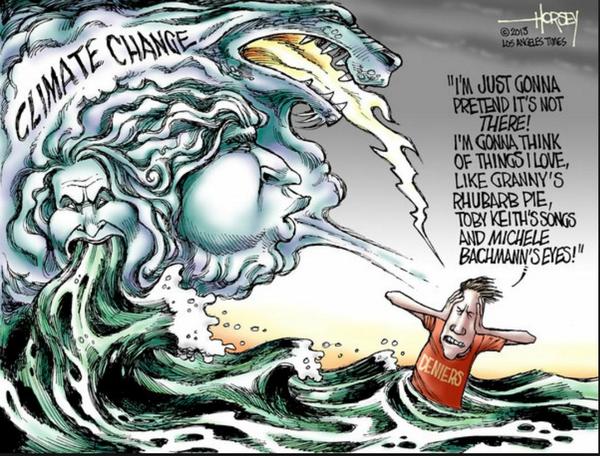
"Granny's Rhubarb Pie"

Saturday, July 12, 2014

Coldest June Ever Recorded in Antarctica

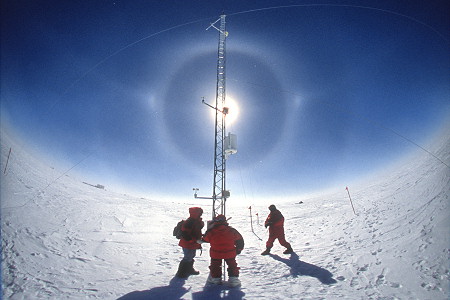
"during June this year, the average [Antarctic] temperature was -22.4c (-8.3F), 6.6c (11.9F) lower than normal. This is the coldest June ever recorded at the station, and almost the coldest monthly average ever – only September 1953 was colder, with a recorded average temperature of -23.5c (-10.3F)."