Showing posts with label Elizabeth. Show all posts

Monday, October 07, 2013

Queen Elizabeth I: A Case of Testicular Feminization?

Serpent or rose?

Abstract

The purpose of this paper is to provide support for the hypothesis that Queen Elizabeth I was a case of testicular feminization (male pseudohermaphroditism) and for the explanation of her contemporaries and of some historians, that she never married because of some congenital defect.

The phenotypical characteristics of the testicular feminization syndrome are strikingly similar to descriptions of Elizabeth's appearance, personality, behaviour, and particularly, to those physical defects which her contemporaries believed made her sterile and unwilling to marry.

Modern historians have rejected the "physical defect" explanation of Elizabeth's refusal to marry in favour of a "psychological" explanation. The basic premise of the "psychological" explanation, that Elizabeth was physically capable of bearing children is unsound for a number of reasons.

Recent advances in our understanding of the process of sexual differentiation, particularly, the description of the testicular feminization syndrome, justify a re-evaluation of the "physical defect evidence" of Elizabeth's contemporaries.
 1985 July; 17(3): 277-84 by R. Bakan (PDF for sale).

See also: "Was Queen Elizabeth I a Man?"

Monday, August 29, 2011

Royal Incest

Elizabeth's Glass - The Mirror of the Sinful Soul by Marc Shell considered the 'best book so far on the specific psychological/political background of incest in the case of Elizabeth Tudor.'
  • Elizabeth's childhood and its rampant incestuous theme
  • one might say incest was the dominating dynamic of her young life
  • her choice at age eleven to translate Marguerite d'Navarre's confessional poem on spiritual incest as a gift for her stepmother the dowager Queen Catherine Parr
  • Marguerite was the mentor of Elizabeth's own mother Anne Boleyn
  • Marguerite was said to have had a passionate affair with her brother the French king
  • prefaces each chapter with a quote from Shakespeare, often from the incestuous closet scene of Hamlet and Gertrude.
(from Michael Dunn)
See Mark Taylor’s Shakespeare’s Darker Purpose: A Question of Incest. And Mark Anderson studies the Polonius-Ophelia relationship in the Winter 2000 edition of the Shakespeare-Oxford Society Newsletter (17-19, 24) in an article titled “Ophelia’s difference, or ‘To catch the conscience of the counselor’”
  • click on the Newsletters section of the SOS website
  • click on Fall 1999 to get the Winter 2000 issue
  • article begins on page 17
http://shakespeare-oxford.com/wp-content/Oxfordian/SOSNL_1999_4.pdf

(from Dan Wright)
In same issue, Winter 2000 Shakespeare-Oxford Newsletter: 'Why Pericles was not included in the First Folio' By Charles Boyle
"Incest is clearly in the background of plays like Hamlet and King Lear, among others, but nowhere is it so obvious as in Pericles. Here the father/daughter relationship is not only obvious, it is at the center of the play, and it is between a king and his daughter. . . If that is so, then Pericles is the one play that makes it all crystal clear, and might lead people to consider . . that . . incestuous behavior at the highest levels of Tudor society dated all the way back to the behavior of Henry VIII, and may have continued right on into the regime of Elizabeth I and her 'Shakespeare.'"

Thursday, August 11, 2011

Prince Tudor II

The Prince Tudor Theory Part II advances the belief that Oxford was the son of Queen Elizabeth I, born in July 1548 at Cheshunt, England. This theory asserts that Princess Elizabeth, then fourteen years old, had a child by her stepfather, Thomas Seymour, and that the child of this affair was secretly placed in the home of John de Vere, 16th Earl of Oxford, and raised as Edward de Vere, 17th Earl of Oxford.

Oxford: Son of Queen Elizabeth I (2001) by Paul Streitz is the primary work advancing Prince Tudor Theory Part II. In addition to making Oxford the queen's son by Seymour, the book also revives the notion that the "Virgin Queen" had children by the Earl of Leicester. These were Robert Cecil, 1st Earl of Salisbury, Robert Devereux, 2nd Earl of Essex, Mary Sidney and Elizabeth Leighton. Finally, she bore Henry Wriothesley, who was the result of an incestuous relationship between Oxford and his mother, the Queen.

This aspect of the Prince Tudor Part II theory is not widely accepted among Oxfordians; most believe that the established date of birth for Oxford (April 12, 1550) is accurate. Thus Elizabeth (born September 7, 1533) would have been 17 years older than Oxford.

Streitz also asserts that Oxford did not die in 1604, but was abducted. The book claims that Oxford was banished to the island Mersea in the English Channel, where he completed Shake-speares Sonnets and The Tempest. He was also the "hidden genius" behind the King James Bible (published in 1611), the unified style of which indicates that it was written by "one clear hand", though much was retained from earlier translations.[25] He died at the end of 1608. This projected date of death is based on the claim that the first written statement referring to Oxford as deceased was in January 1609, followed by the publication of the sonnets ascribed to the "ever-living" poet. Streitz follows the common Oxfordian argument that "ever-living" is a euphemism for "deceased".

SEE: http://en.wikipedia.org/wiki/Prince_Tudor_theory

Friday, August 05, 2011

Who Wrote the Sonnets?

A new book by a Tasmanian scientist argues that Shakespeare’s Sonnets were not written by the great bard, but by someone even more illustrious. Dr. Peter McIntosh of Hobart questions the traditional academic view that accepts that Shakespeare wrote the Sonnets.
“There is no doubt that there was an actor called William Shakespeare. But the orthodox belief that the actor Shakespeare wrote the immortal sonnets is just that – a belief. The only evidence we have that Shakespeare wrote the sonnets is his name on the title page. But this in itself does not prove authorship. There is no independent evidence such as a signed manuscript to prove that Shakespeare’s wrote the sonnets.”


Dr. McIntosh said there were several problems with the traditional authorship consensus, which the Shakespeare academic fraternity seems unwilling to consider. “For example, most of the sonnets are love poems addressed to a good-looking youth with a fair complexion. If Shakespeare wrote the sonnets, the obvious implication for the reader is that he was a homosexual. Would Shakespeare have risked publishing self-incriminating sonnets in his own lifetime? Another problem is the frequent reference in the sonnets to the author being old and near death. In Elizabethan times life expectancy was much lower than at present. Such a reference would mean that the author was in his late fifties or early sixties. But Shakespeare was only thirty or so, and in his prime of life when the sonnets were written. Even when aged fifty-one he wrote in his will that he was in good health. No scholars have ever explained this age discrepancy.”

Thursday, August 04, 2011

Sonnets by Mary, Queen of Scots?

The Casket Letters Discovered

On the 20th June 1567, a few days after Scottish rebels apprehended Mary, Queen of Scots, servants of James Douglas, 4th Earl of Morton, allegedly found a silver casket of . .
  • eight letters
  • two marriage contracts,* and 
  • twelve sonnets 
. . in the possession of James Hepburn, 4th Earl of Bothwell and third husband of Mary Queen of Scots.
------
'John Guy writes of how the sonnets found in the casket “were said to be Mary’s own reflections on her adultery” with Bothwell and proof “that her consuming passion for Bothwell gave her a powerful motive for murder.” However, Guy points out that they are highly unlikely to be genuine as “they are extremely clumsy and would pass only with the greatest difficulty as the work of a native French speaker” and they do not fit with the “genre of courtly love poetry” with which Mary was familiar. He also points out that they can be read as religious poetry.'

*which apparently proved that Mary had agreed to marry Bothwell before his divorce.

My Heart is My Own: The Life of Mary Queen of Scots, John Guy (2004)

SEE: The Elizabeth Files

Mary, Queen of Scots

Saturday, July 16, 2011

Was Queen Elizabeth I a Man?

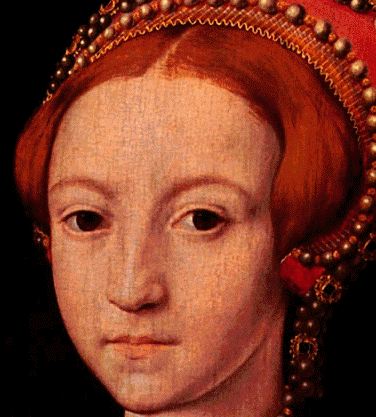
Elizabeth as a girl
If you ever wondered why Queen Elizabeth I (1533–1603) never married, a thriller by an American writer might contain the answer: "Good Queen Bess" was a man in drag.

As the last of the Tudor line, her most urgent duty was to provide an heir. Instead she declared herself the Virgin Queen, vowed never to take a husband, and stuck to her oath, even though it provoked a war with Spain. She defiantly proclaimed: "I have the heart of a man, not a woman, and I am not afraid of anything."1

Because she died "without issue", the House of Stuart came to power and the English throne was handed over to a Scottish king.

Steve Berry apparently thinks Elizabeth was telling the actual truth: she had the heart of a man because she was one. He spent a year and a half researching this possibility for his novel The King’s Deception in 21st-century London.

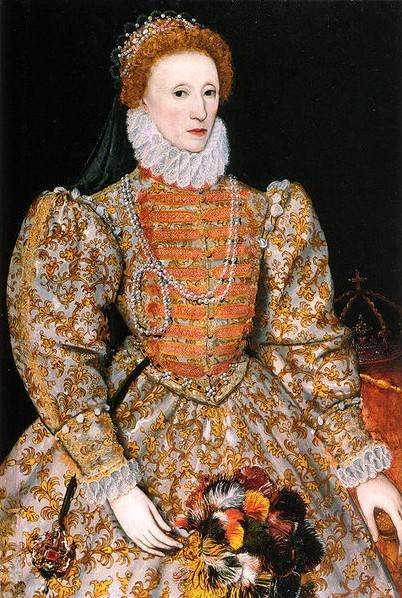
somebody else in drag?
As a girl, Elizabeth may have had a nice feminine figure, but a portrait made shortly after she became queen disguises her broad shoulders and neck with heavy furs. She wears a wig, which she would from then on, and her eyebrows are plucked. Her jaw is heavy and square, her chest flat. The neck ruff might cover an Adam's apple. She always used thick drag queen-like makeup. (Another portrait seems to suggest she needed a shave.)

    Bram Stoker and "The Bisley Boy"

    Bram Stoker, famous author of Dracula, stumbled on an interesting legend regarding Queen Elizabeth and his digging resulted in a chapter of his book “Famous Imposters” (1910) being devoted to “The Bisley Boy”.

    (needing a shave)
    Stoker wasn’t just an author, he was also the personal assistant of the actor Henry Irving who had been looking for a house in the Cotswolds in Gloucestershire, England.

    It was in the village of Bisley that Irving came across the legend of “The Bisley Boy” and he passed the story on to Stoker who was keen to investigate. Both Stoker and Irving were intrigued by the fact that the village’s May Day celebrations involved a boy May Queen dressed in Elizabethan costume. Such traditions are generally based on an historical event or legend and Stoker wanted to find out more about this one.2

    Stoker, hearing stories that a coffin had been discovered by a clergyman at Bisley during the early 1800s with the skeleton of a girl dressed in Tudor finery, first captured the legend in book form.3 For the man who popularized the legend of Dracula, it was the most plausible explanation for why Elizabeth never married.1

      1. "Is this proof the Virgin Queen was an imposter in drag? Shocking new theory about Elizabeth I unearthed in historic manuscripts" by Christopher Stevens, Daily Mail; June 7, 2013.
      2. "The Bisley Boy" by Claire, The Elizabeth Files: The REAL TRUTH about Queen Elizabeth I; November 4, 2009.
      3. In 2013 Sarah Skye updated and published a Kindle version entitled Was Queen Elizabeth a Man? - The Bisley Boy Story.