You could name your first son Jasper
. . In honor of the clown
I'd steer well clear of Casper
. . (Unless you're in a ghost town.)
September 29, 2011
Thursday, September 29, 2011


Monday, September 19, 2011
The Premiere of 'Anonymous'
'I think you will all love it. I also think that the movie will on the whole be a good thing for the Oxfordian movement. Certainly, Stratfordians will have a field day nitpicking all of the liberties that Emmerich has taken with history and "received wisdom", but they will not be able to stop people from finding this a great story and wanting to know more about it. That's where all of us come in. I hope we will be ready for it.'
SEE: Oberon Shakespeare Study Group
SEE: Oberon Shakespeare Study Group
Friday, September 16, 2011
"I've Arrived!"
A car that says
. . I've arrived!
When the stock market
. . Has dived
Sends a message of
. . Power
Down from
. . Pride Tower.
September 16, 2011

. . I've arrived!
When the stock market
. . Has dived
Sends a message of
. . Power
Down from
. . Pride Tower.
September 16, 2011
"Respect Your Space"
Get your f^%#ing finger out of my face!
Hope you never say this to your father
But until he learns to respect your space
He's just bullying mother.
September 16, 2011
Hope you never say this to your father
But until he learns to respect your space
He's just bullying mother.
September 16, 2011
"The Very Damn Coolness"
The very damn coolness
. . That you exude
Goes into the furnace
. . When you are rude.
September 16, 2011

. . That you exude
Goes into the furnace
. . When you are rude.
September 16, 2011

Thursday, September 15, 2011
"The Day That God Made Woman"
The day that God made Woman
He had a headache Himself
He forgot the reset button
To put Her back on the shelf.
September 15, 2011
He had a headache Himself
He forgot the reset button
To put Her back on the shelf.
September 15, 2011
Ice-Cream Flavor Cemetery in Vermont
"Located on a hill, behind the famous Waterbury ice-cream factory, the Flavor Cemetery features hundreds of plastic tombstones, for every wacky flavor ever launched by Ben & Jerry’s. Each tombstone has an artist-written epitaph and a list of ingredients of the 'deceased' ice-creams. Since the birth of Ben & Jerry’s, 200 flavors that have failed to impress customers, ended up pushing daisies in the Flavor Cemetery."SEE: Oddity Central - Collecting Oddities

"A Three-Poem Day"
A three-poem day
So long since seen the like
Without a thing to say
My Muse must take a hike?
September 15, 2011

So long since seen the like
Without a thing to say
My Muse must take a hike?
September 15, 2011

"A Rainy End to Summer"
A rainy end to Summer
Tomato plants to shield
Might present a bummer
Lest stormy clouds yield.
September 15, 2011
Tomato plants to shield
Might present a bummer
Lest stormy clouds yield.
September 15, 2011
Wednesday, September 14, 2011
"The Derby theory . . has guided me to discover that the German play Prinz Hamlet is in fact the Ur-Hamlet that was considered missing and lost forever . . it is the same Derby theory that has guided me to the theory about the cause of Hamlet’s delay . . Considering all this, it seems justified to examine the subject of the theory, the 6th Earl of Derby."CARL O. NORDLING
FROM: "Shakespeare: Who wrote Hamlet and why?"
Tuesday, September 13, 2011
One Side of Hardwick
"He only covers one side of the town. There's the side of the town that's for the local food movement, but I think there's an even greater side of the town, with more people, that can't afford the local food. I work at our local supermarket grocery store, and I see most of the people in town there."
DEREK DEMERS
High school senior who works at Grand Union, referring to The Town That Food Saved: How One Community Found Vitality in Local Food
 by Ben Hewitt.

SEE: "Vermont Town's Food Focus Still A Growing Concept" by Dan Charles, July 15, 2011.
'Next Big Thing': Hardwick, Vermont
"Starting a few years back, the place basically reinvented itself as one large co-op, with vibrant community-agricultural programs, a year-round farmers' market, and a program that rents kitchen space to local food producers. It also serves as a gateway to the wild, woolly Northeast Kingdom. From downtown, you're just 20 minutes from skiing in Stowe, fly fishing near Johnson and mountain biking in East Burke."OUTSIDE Magazine, "Where to Live Now: 19 Perfect Towns".

FROM: "Hardwick Hailed As Outdoor Utopia" by Taylor Reed, The Caledonian-Record, Steptember 13, 2011.
"Through Her I Have Grown"
I've sent my love letters
My love I have shown
It's Love my life betters
Through Her I have grown.
September 12, 2011

My love I have shown
It's Love my life betters
Through Her I have grown.
September 12, 2011

Tuesday, September 06, 2011
'Total Rubbish'
“What is maddening is that it is a high-budget film with a rather good cast, and may be so good that a lot of people who get their history from films may think it is somehow authentic. My fear is that the film will be done well. The Oxfordians have been around since the 1880s, and I have always tried never to think about them because it is all total rubbish.”OXFORD UNIVERSITY Professor Katherine Duncan-Jones on ANONYMOUS
FROM: "Earl’s cast as the true bard in film" by Liam Sloan, Oxford Mail; 3rd September 2011.

Monday, September 05, 2011
New Bardgate Book Resolves Shakespeare Identity Dispute?
Bardgate: Shake-speare and the Royalists Who Stole the Bard
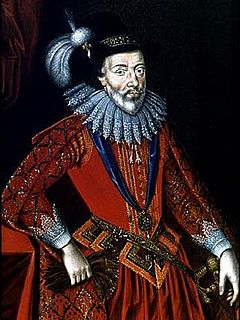 |
| 6th Earl of Derby, William Stanley |
Are you an Oxfordian paranoid about the deleterious impact that the big budget Roland Emmerich/Sony movie entitled Anonymous will have on your movement because it peddles a salacious, sex-drenched narrative and a totally erroneous variant on the Oxfordian theory before the unsuspecting masses?
Lament or fear no more. You have another path to the truth before you finally 90 years after two remarkable scholars—Abel Lefranc and J. Thomas Looney—delivered a two-barrel shotgun blast at the Stratfordian Orthodoxy by advancing independently arguments in 1919-1920 in favor of the Earls of Derby and Oxford, the latter (Edward de Vere) being the father-in-law of the former (William Stanley).
Bardgate: Shake-speare and the Royalists Who Stole the Bard conclusively proves that an intuition of a more complex Oxford-Derby symbiosis—or Dual Bard—sensed by Looney and some other anti-Stratfordians in Britain and France in the 1920s is in fact the truth.
Those interested in obtaining a copy of the book should contact the author as soon as possible:
Peter W. Dickson
3515 North Pershing Drive
Arlington, Virginia 22201
Phone: 703-243-6641
Email: pwdbard@aol.com
Anonymous: William Shakespeare Revealed (Newmarket Pictorial Moviebook)
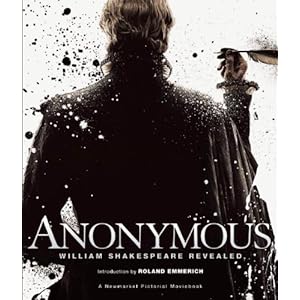
One of two official movie tie-ins—With 165 color images, a large-format visual companion to the political thriller film Anonymous, which imagines Edward de Vere, the Earl of Oxford, as the true author of the plays credited to William Shakespeare. A riveting story and a striking portrayal of the Elizabethan period—full of opulent costumes, greedy nobles, illicit romances at the royal court, and bawdy playwrights—the movie Anonymous is captured in this stunning pictorial book that describes how the film was developed and produced. Divided into five sections, it includes:
- a fascinating essay by director Roland Emmerich about what he calls "the single greatest filmmaking experience of my life"
- an essay by screenwriter John Orloff (Band of Brothers, Legends of the Guardians, A Mighty Heart) explaining how this idea finally became a major motion picture over the span of ten years
- a humorous piece by Mark Twain discussing the Shakespeare authorship question
- an enticing argument by Charles Beauclerk, author of Shakespeare's Lost Kingdom, suggesting that his ancestor, Edward de Vere, is the true author
- commentaries from the cast and crew on the film's production, costume design, locations, sets, cinematography, and visual effects
- production sketches, concept illustrations, script excerpts
- sidebars on historical references, chronologies
- an extensive bibliography
Publisher: Newmarket Press (September 13, 2011)
Language: English
ISBN-10: 1557049750
ISBN-13: 978-1557049759
The Assassination of Shakespeare's Patron
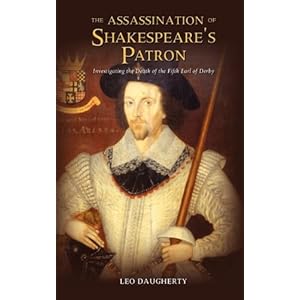
Lord Ferdinando Stanley was the Fifth Earl of Derby, a leading claimant to the throne. He was also the patron of the company of players which included the man now known as William Shakespeare. Lord Stanley was incalculably rich, having married one of the wealthiest heiresses in England. His home in Lancashire was called the "Northern Court" because of its grandness, surpassing any in England but (perhaps) the Queen's own.
On April Fool's Day, 1594, he was reportedly approached by a witch--one of the famous legion of "Lancashire witches"--and they engaged in brief conversation while strolling outside his largest palace, Lathom Hall. Four days later he fell violently ill. For twelve days he lingered, while four of the best doctors in the country, including the famous Dr. John Case of Oxford, labored in vain to save him. Two of his retainers wrote gruesomely detailed accounts of the progress of his "diseases"--accounts that survive in manuscript today. When he died, Dr. Case was heard to murmur: "Flat poisoning. And none other but."
For months after his passing and interment, no one could get close enough to the family crypt to pay his or her respects because of an overwhelming stench that continued to emanate from his body.
Who killed him and why? Historians started debating that question almost as soon as he died, and outraged gossip was to be heard everywhere in England.
The Assassination of Shakespeare's Patron: Investigating the Death of the Fifth Earl of Derby
Author: Leo Daugherty
Hardcover: 374 pages
Publisher: Cambria Press (May 18, 2011)
Language: English
ISBN-10: 160497737X
ISBN-13: 978-1604977370
Friday, September 02, 2011
'Distinct Lancastrian Leanings'
'Assuming him to have been an Englishman of the higher aristocracy, we turn now to these parts of his writings that may be said to deal with his own phase of life, namely, his English historical plays, to seek for distinctive traces of position and personality. Putting aside the greater part of the plays "Henry VI," parts 1 and 2, as not being from Shakespeare's pen, and also the first acts of "Henry VI," part 3, for the same reason, we may say that he deals mainly with the troubled period between the upheaval in the reign of Richard II and the ending of the Wars of the Roses by the downfall of Richard III at the Battle of Bosworth. The outstanding feature of this work is his pronounced sympathy with the Lancastrian cause. Even the play of "Richard II," which shows a measure of sympathy with the king whom the Lancastrians ousted, is full of Lancastrian partialities. "Shakespeare" had no sympathy with revolutionary movements and the overturning of established governments. Usurpation of sovereignty would, therefore, be repugnant to him, and his aversion is forcibly expressed in the play; but Henry of Lancaster is represented as merely concerned with claiming his rights, desiring to uphold the authority of the crown, but driven by the injustice and perversity of Richard into an antagonism he strove to avoid. Finally, it is the erratic wilfulness of the king, coupled with Henry's belief that the king had voluntarily abdicated, that induces Bolingbroke to accept the throne. In a word, the play of "Richard II" is a kind of dramatic apologia for the Lancastrians. Then comes the glorification of Prince Hal, "Shakespeare's" historic hero. Henry VI is the victim of misfortunes and machinations, and is handled with great tenderness and respect. The play of "Richard III" lays bare the internal discord of the Yorkist faction, the downfall and destruction of the Yorkist arch-villain, and the triumph of Henry Richmond, the representative of the House of Lancaster, who had received the nomination and benediction of Henry VI. We might naturally expect, therefore, to find Shakespeare a member of some family with distinct Lancastrian leanings.'"Shakespeare" identified in Edward De Vere, the seventeenth earl of Oxford By J. Thomas Looney (1920) emphasis added
Subscribe to:
Posts (Atom)